

English - Writing
Communication and creativity are at the heart of our writing vision at Lime Tree Primary School.
We view writing as a powerful bridge between mastering communication and unlocking personal creativity.
Literacy is a daily priority from the Early Years through to Year 6, using captivating example texts to model excellence and spark original ideas.
At our school, we use the CUSP Writing, Reading, and Spelling curriculum from Years 1 to 6 to ensure a consistent, high-quality approach to English across all year groups. CUSP (Curriculum with Unity Schools Partnership) is a structured and evidence-informed programme that carefully sequences learning to build knowledge, vocabulary, and skills progressively over time.
Writing in the Early Years Foundation Stage (EYFS)
In EYFS we believe that to be a successful writer the children need to have both the desire to have something to write about, and the physical capability to master a writing tool. To inspire the children to write we carefully plan play opportunities throughout our learning environment so that children see writing as part of play, and a vital means to communicate. As adults, we model this by immersing ourselves in their play so we can model purposeful writing and encourage the children to follow our lead.
In our continuous provision we follow the GLF Primary Curriculum, which uses high quality texts to expose children to rich, exciting vocabulary, and then gives them an inspirational theme to write about independently. In addition to this, we follow Read Write Inc where children are able to practise their handwriting every day. This approach not only exposes the children to a range of new vocabulary whilst providing a purpose for mark making, but also provides an extended period of time where children are using mark making tools and developing their fine motor control and pen grip. As the year progress, children will take part in activities where they have the opportunity to apply their developing phonic knowledge to a range of exciting writing opportunities, within all areas of the curriculum.
KS1 & KS2 CUSP Writing Curriculum
Sequence and progression:
CUSP Writing is built on a Reduce and Revisit model. This means that we have reduced the number of text types that pupils study, in favour of revisiting a small number that we want them to truly master. These text types have been carefully selected to ensure balance and progression across the whole of the primary journey.
CUSP Writing - Text Type Progression
The CUSP curriculum is underpinned by a clear programme of study that sets out what pupils should know and be able to do in each domain of writing. This is fully aligned to the National Curriculum. These concepts are mapped into each block of writing planning, with plenty of opportunities to revisit previous knowledge. Example below:
CUSP - Example of Year Group National Curriculum
CUSP - Long Term Year Group Sequencing
Teaching and learning:
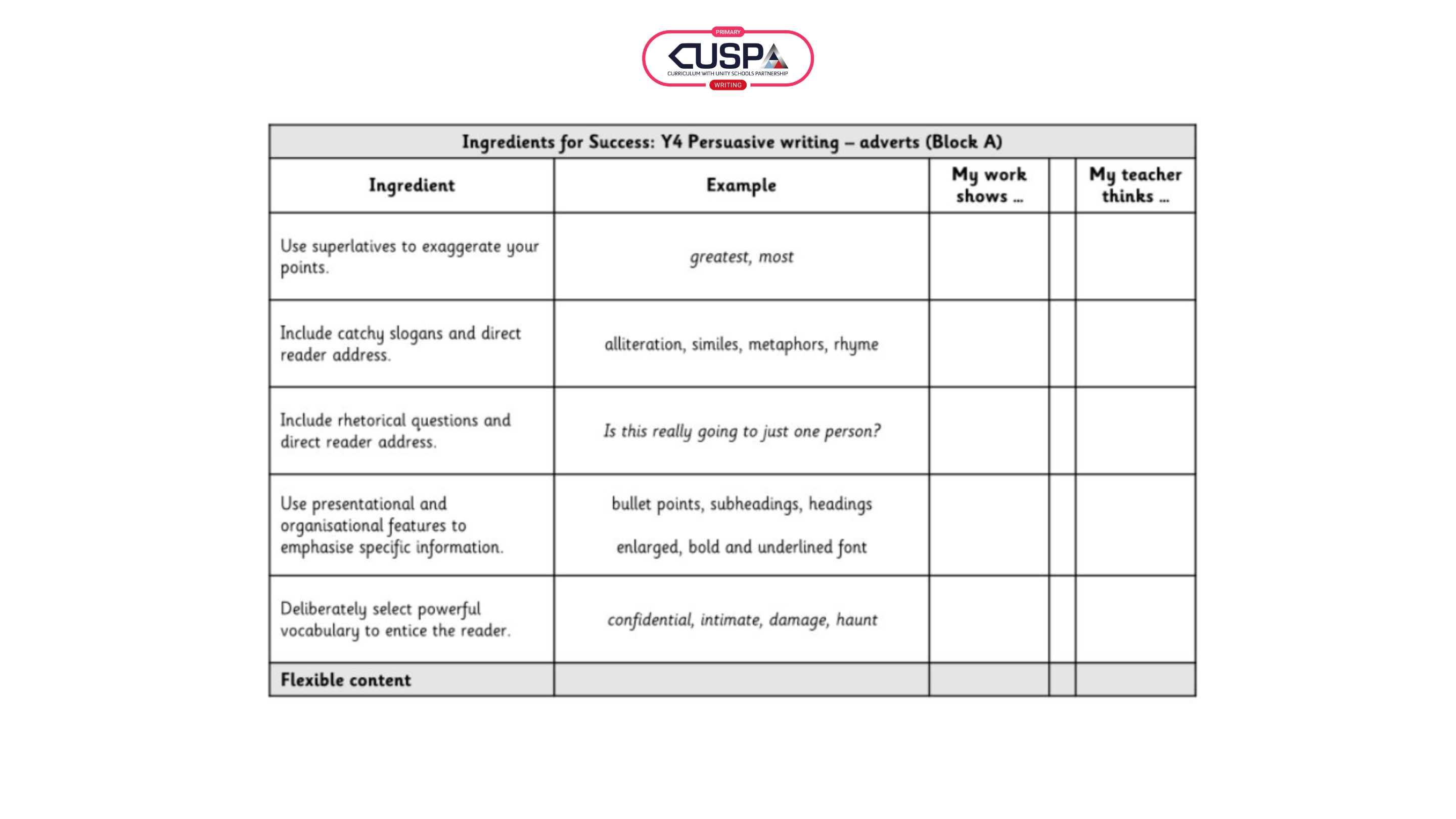
Each unit has an Ingredients for Success checklist. Teachers and pupils use this to support their assessment of the extended outcome. Teachers use these to support their marking and feedback of the extended outcome, identifying concepts which are secure and can be built on and those that require additional instruction.
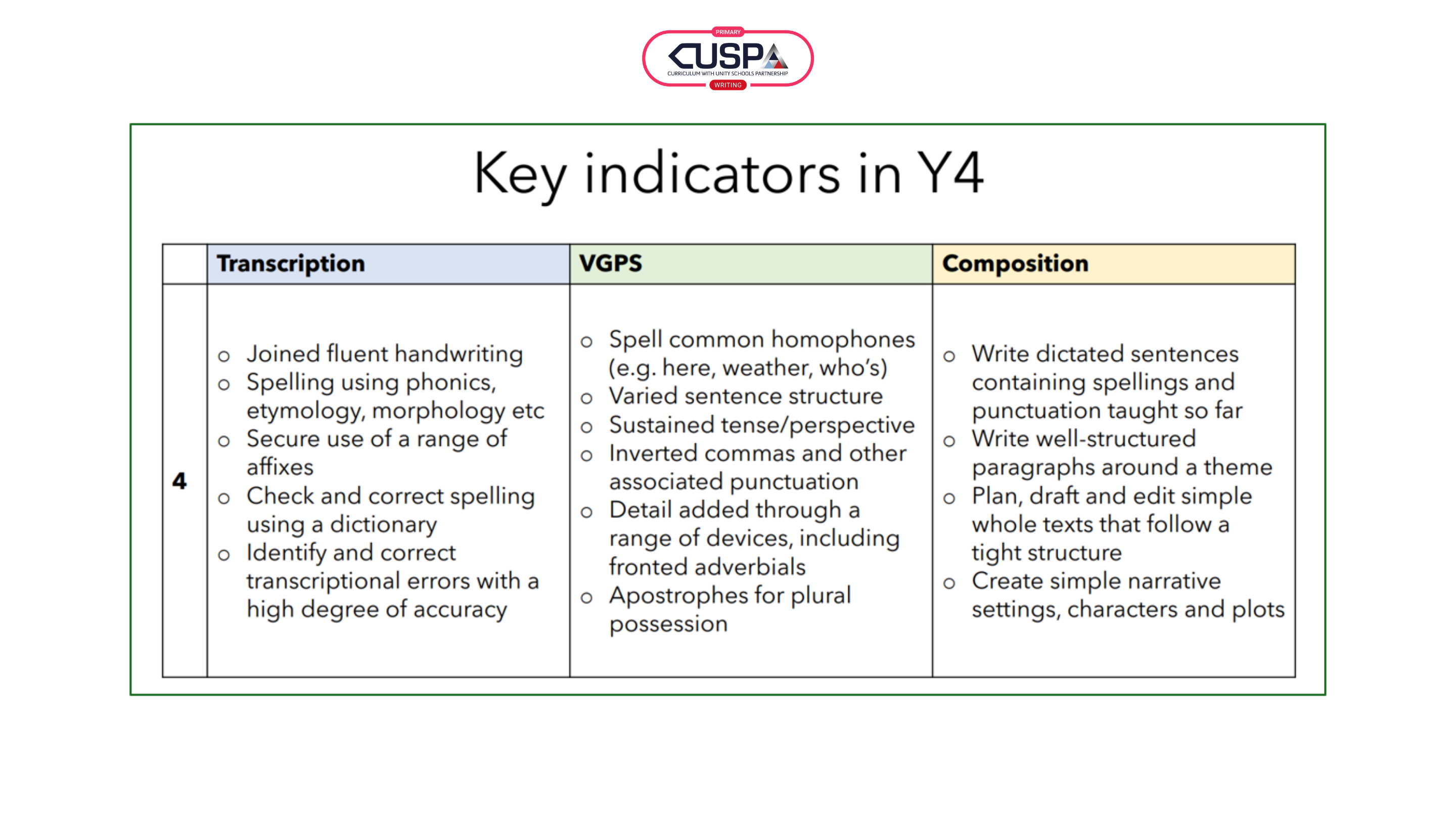
 We use the Key Indicators as a summative tool that can be used to answer the question ‘Have pupils learned what is intended in the curriculum?’. If, across the portfolio of Block B units, pupils can show security against all elements of the Key Indicators, pupils have learned what is intended. If there are gaps for individuals, this information can be used to reshape practice and support teachers in addressing areas of weakness for individual pupils or cohorts.